
Recent Posts
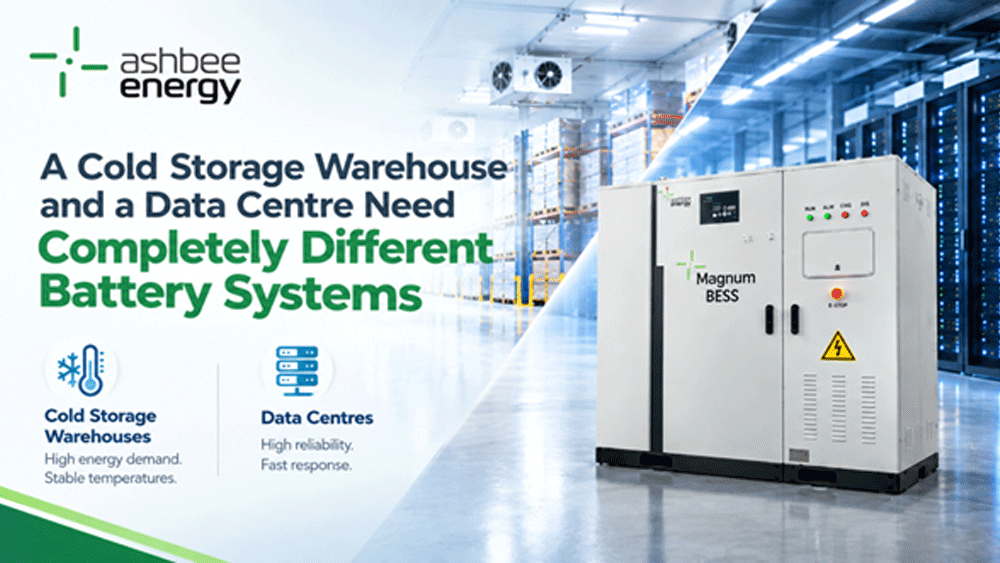
A Cold Storage Warehouse and a Data Centre Need Completely Different Battery Systems
Imagine two businesses asking for a battery quote in the same week. One runs a cold storage warehouse. The other runs a data centre. If both receive the same standard proposal, at least one of them will end up with the wrong system.
This can happen when a supplier starts with a product instead of the site. The good news is that it is easy to avoid. This guide explains what a BESS for cold storage needs, what a BESS for data centres needs and why they are so different.
Why Every Industry Needs Its Own Battery Design?
Picture a hotel's evening load. Power use climbs when guests return to their rooms and the restaurants get busy. It stays high for a few hours, often during peak tariff hours. Then it drops. A solar battery energy storage system sized for that pattern would be a poor fit for a cold storage facility. There, compressors run all day and all night. That kind of operation needs deeper daily cycling capacity. It also needs enough power to handle compressor starts. Large compressor motors can draw several times their normal current for a few seconds when they switch on.
The stakes are high. India loses about ₹1.53 lakh crore of agricultural produce after harvest every year, according to a 2022 NABCONS study. Reliable cold storage, backed by reliable power, helps protect that produce.
Medicines need the same care. In February 2021, a backup generator failed at the Harris County health department in Texas during a winter storm. As its freezers began to thaw, officials had to rush to use 8,430 doses of Moderna vaccine. A battery system adds one more layer of protection for cooling like this.
Data centres have a different priority. Downtime there can cost a great deal in a very short time. Renewable energy storage solutions built for this sector need very fast switchover and tighter voltage regulation. They also need extra backup layers that a warehouse may not need.
A well-known case shows what is at stake. On 27 May 2017, an engineer disconnected a power supply at a British Airways data center near Heathrow. When the power was reconnected, the surge caused major damage. Hundreds of flights were cancelled over two days and at least 75,000 passengers were affected. For a data center, clean and stable power matters as much as backup.
This is why the first question should be different for each industry. For cold storage, start with cycle life, because the battery works hard every day. For a data center, start with switchover speed. For a manufacturing plant, start with demand charges.
What Manufacturing Facilities Actually Priorities?
Peak demand charges drive most of this conversation in a manufacturing plant. Battery energy storage systems (BESS) built around this goal discharge during the most expensive hours and recharge when power is cheaper. Many industrial tariffs include a demand charge, which is often based on the highest demand recorded in the month. Lowering that peak can bring a clear saving on every bill. BESS power backup still matters here too.
For some plants, even a short power cut is very costly. On 15 June 2019, the power at the Toshiba Memory and Western Digital flash memory plants in Japan stopped for just 13 minutes. Western Digital later said it would have about six Exabyte’s less flash memory available. That is about six billion gigabytes, enough storage for roughly 47 million phones with 128 GB each. A power cut shorter than a tea break caused all of it.
Matching BESS Solutions to Actual Load Patterns
A load audit is the step that makes everything else work. A facility manager who is sold a generic BESS solutions package without a load audit is likely to pay for capacity that sits unused or buy less than the site needs in peak season. Both mistakes are easy to avoid with good data.
A battery system delivers the most value when it is sized using actual hourly load data rather than a rough estimate from one electricity bill. Ideally, that data covers a full year so that seasonal peaks such as summer cooling are included.
Ashbee Energy recommends starting every commercial and industrial energy storage project with a load study. A cold storage facility and a data center each get a system designed around their own needs.
To plan a system for your site, write to sales-energy@ashbee.com.
The Real Takeaway for Facility Decision-Makers
Every industry uses power in its own way. A system designed around your site makes the most of that. The right system depends on load pattern, downtime cost, and operating hours specific to that one facility rather than an industry average.
Leave a Reply
Your email address will not be published. Required fields are marked
Comments