
Recent Posts




What Goes Into Laptop Batteries Before They Ever Reach Your Office?
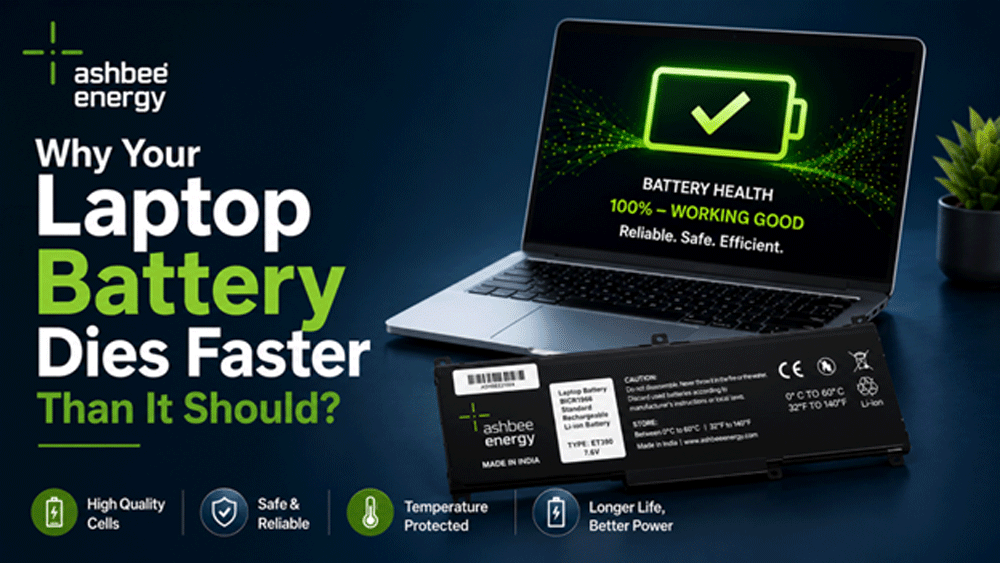
Open an old laptop battery and the first surprise is how ordinary it looks: a few silver cylinders held together with nickel strip and a small green board. What separates a battery that ages well from one that fades early is mostly hidden inside those cylinders. It was decided at the factory long before any welding. For a business buying laptop batteries in volume, that is the interest-ing part. Yet hardly anyone sees it. Here is how OEM laptop batteries are made, step by step.
The cells come first
Many laptop batteries use a cell called the 18650. The name sounds like a model number. It is really a size code. The cell is 18 mm across and 65 mm long. The final 0 shows that the cell is round..Many thin laptops use flat polymer cells instead. So check which kind your laptops use before you order. .Inside each cell, a wet paste is coated onto thin metal foil. Aluminium foil is used for the positive side and copper foil for the negative side. The coated foil is dried, pressed thin and wound into a tight roll.
The room matters as much as the materials. The liquid electrolyte is added in a dry room be-cause even a trace of moisture can damage it. Fraunhofer, a leading research institute, describes a dry room dew point of minus 60°C for this work. That is far drier than any office. After that comes the first charge, called formation.. The cells are then stored and watched in a step called ageing. Formation and ageing together can take up to three weeks. Cells that lose charge too fast in this time are rejected.
From cells to a pack
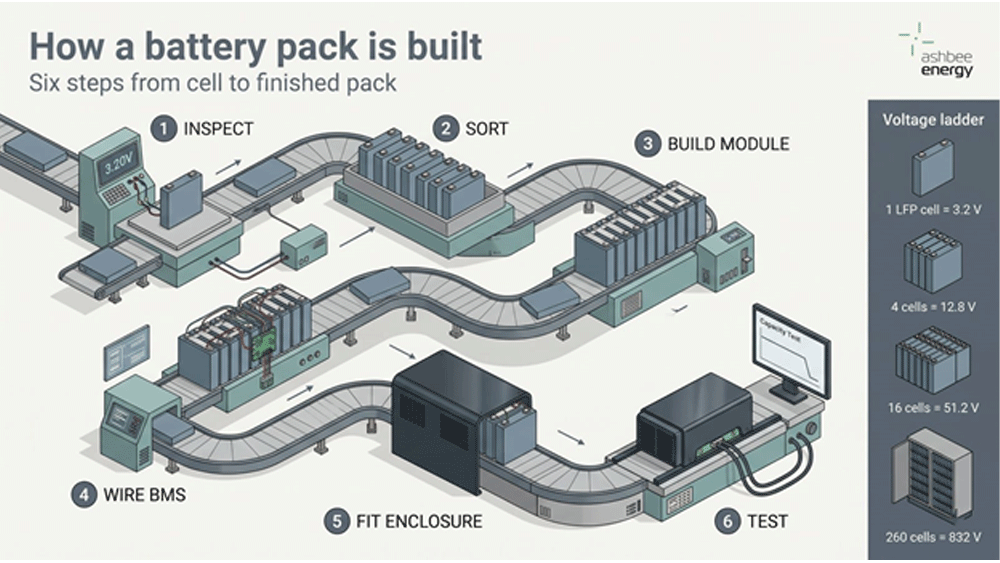
No two cells come out exactly the same So cells are tested and sorted by capacity and internal resistance. A pack behaves like its weakest cell.. That is why careful sorting matters more than the name printed on the label. The cells are then arranged to give the voltage and capacity the laptop needs..For example, three cells in series give 11.1 V. Two such strings side by side with 2,600 mAh cells give about 58 Wh.Nickel strips are welded on to join the cells. Then a protec-tion board is added and the housing is closed. This board does a lot of work. It stops the cells from charging past a safe voltage. It cuts power if there is a short circuit. It also works out the battery health figure your laptop shows.
What to Ask Before You Order
Cheaper packs may skip the grading step or mix in lower-grade cells. Buyers often find out months later when capacity drops faster than it should. Before a laptop battery replacement order goes out, ask the supplier three questions. Who made the cells? How were they matched? Is there a test report for your batch? The capacity printed on the box cannot answer any of these.
At Ashbee Energy's factory in India, incoming cells are checked and matched for capacity, inter-nal resistance and voltage before they go into a laptop battery. Any buyer, from a repair business to a laptop brand, should expect that kind of clear answer from a supplier.
Leave a Reply
Your email address will not be published. Required fields are marked
Comments